
How to Hang Heavy Shelves on Drywall Without Studs
You’ve found the perfect spot for a new shelf, marked your bracket positions, and then your stud finder beeps frantically across the entire wall with no solid wood in sight. It’s a frustrating scenario that happens constantly in modern homes with 16-inch stud spacing. The good news: you can safely hang heavy shelves on drywall without studs, with the right anchors and techniques.
This guide walks you through every step to mount heavy-duty floating shelves, bookcases, or kitchen racks securely. You’ll learn which anchors actually hold weight, how to install reinforcement systems, and exactly how to calculate safe weight limits for your specific setup.
Choose the Right Anchor for Heavy Loads on Drywall Without Studs

Standard plastic anchors will fail under heavy shelves. The secret to stud-free mounting is transferring weight behind the drywall where the material is thicker and can grip the anchor from both sides.
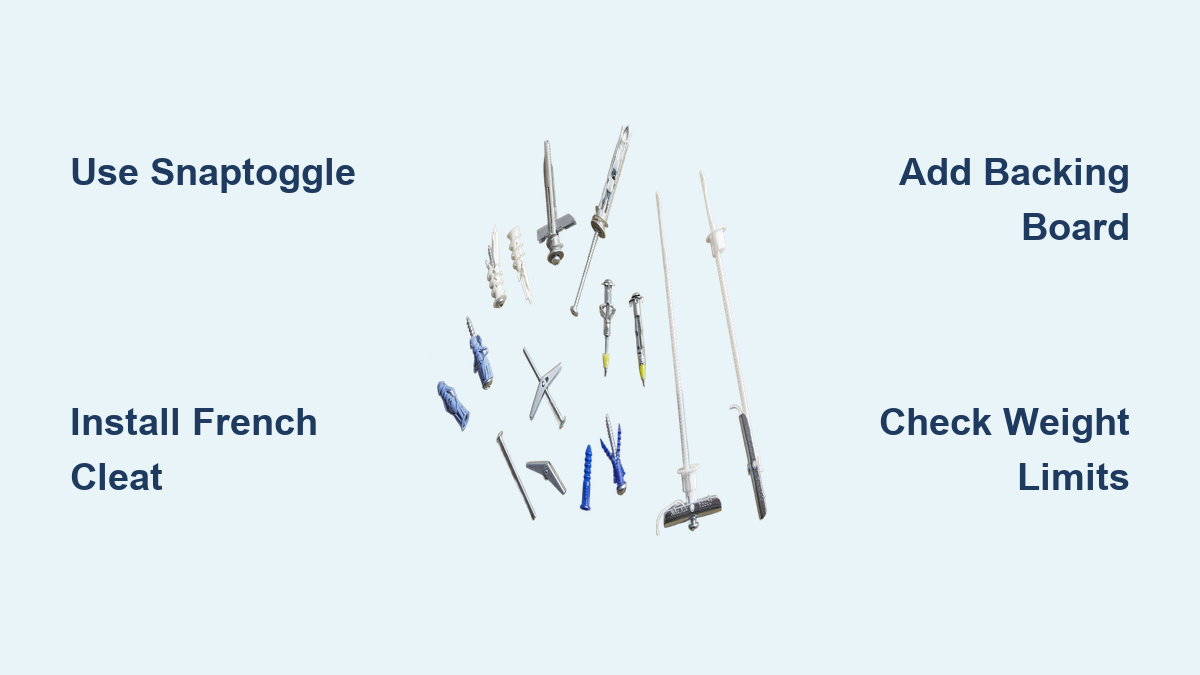
SNAPTOGGLE Anchors: Strongest Drywall Anchor
SNAPTOGGLE anchors are the gold standard for hanging heavy shelves on drywall without studs. These spring-loaded steel wings expand behind the wall, gripping the drywall from the back. One anchor holds up to 356 pounds in 5/8-inch drywall, making it strong enough for most bookshelves and built-in units.
Why SNAPTOGGLE works:
• Wings open automatically when inserted through the hole
• No need to reach behind the wall during installation
• Reusable and easy to remove if needed
• Works in both 1/2-inch and 5/8-inch drywall thickness
Installation tip: Drill a 1/2-inch hole, insert the anchor, and tighten the screw. As the screw pulls, the wings clamp the drywall securely from behind. Always use at least two anchors per bracket for heavy loads.
Flat Strap Toggles for Maximum Load Distribution
Flat strap toggles feature wide metal plates that lie flush against the back of the drywall. Once inserted, you tap a nail or screw from the front to lock the plate in place. These anchors support up to 200 pounds per anchor.
Best for: Deep floating shelves, media consoles, or any shelf with significant cantilever where weight pulls away from the wall.
Advantage: The broad backplate spreads load over a larger area, reducing stress on the drywall and preventing the anchor from pulling through.
Toggle Bolts for Medium to Heavy Loads
Classic toggle bolts use folding metal wings that open behind the drywall. When tightened, they clamp the wall from both sides. Weight capacity ranges from 50 to 100 pounds per anchor depending on size and drywall thickness.
Best for: Medium-heavy shelves when SNAPTOGGLE anchors aren’t available.
Drawback: Requires a larger hole (up to 5/8-inch), which increases the risk of drywall damage and makes installation harder in tight spaces.
Molly Bolts for Medium-Duty Applications
Molly bolts have a metal sleeve that expands as you tighten the screw, gripping the back of the drywall. They support 25 to 75 pounds per anchor.
Good for: Kitchen shelves or display units under 75 pounds.
Limitation: Can loosen over time under vibration or shifting loads. Not ideal for very heavy or dynamic use.
Install Shelves with a French Cleat System
For a secure, removable, and stud-free solution, use a French cleat system. This method relies on mechanical interlocking rather than just screw strength.
How the French Cleat Works
A French cleat consists of two beveled strips: one mounted on the wall, the other on the back of the shelf. When you slide the shelf upward, the two pieces lock together, distributing weight along the entire length of the cleat instead of concentrating force on individual screws.
Why it’s safer:
• Eliminates direct pull-out force on screws
• Allows tool-free removal for seasonal decor changes
• Supports hundreds of pounds when paired with strong anchors
French Cleat Installation Steps
1. Attach wall cleat with toggle anchors
• Mark a level line where the cleat will go
• Pre-drill holes using a 5/16-inch bit
• Insert SNAPTOGGLE or toggle bolts at each mounting point
• Screw the wall cleat into the anchors, ensuring it’s perfectly level
2. Secure shelf cleat
• Position the second cleat piece on the back of the shelf
• Pre-drill holes to prevent wood splitting
• Attach with 1-inch wood screws
3. Lock shelf into place
• Align the shelf cleat with the wall cleat
• Lift and slide the shelf upward until it clicks into place
• Check with a level and adjust if needed
Pro tip: Use a mallet to gently tap anchors flush if they don’t seat fully during installation.
Reinforce the Wall with a Backing Board
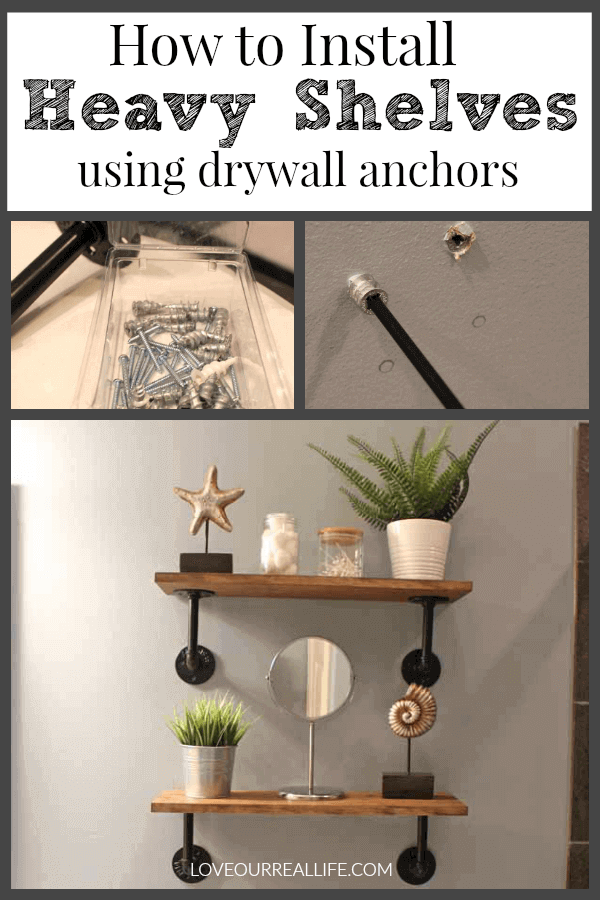
When anchors alone aren’t enough for very heavy loads, create a solid mounting surface using a backing board or plywood panel.
Horizontal Backing Board Method
This technique installs a solid wood strip across the wall, anchored into multiple studs for maximum support.
Steps to install:
1. Cut a 1×3 or 1×4 board to span at least two studs (typically 32 inches long)
2. Locate studs with a stud finder and mark their centers
3. Screw the board into each stud using 2.5-inch wood screws
4. Use toggle bolts at the ends if the board extends beyond studs
5. Paint or stain to match your trim
Now mount your shelf brackets directly onto the board. The load transfers into the studs, bypassing weak drywall entirely.
Ideal for: Kitchen shelves, built-ins, or media units holding over 200 pounds.
Full Plywood Backing Panel
For maximum flexibility, cover a large wall section with a 1/2-inch or 3/4-inch plywood panel.
Installation:
• Measure the area between door frames or cabinets
• Cut plywood to fit precisely
• Attach edges to doorframe studs (usually doubled)
• Fasten center to any available stud
• Use snap toggles where no stud exists
• Finish with paint or trim to blend with walls
Benefits:
• Allows future shelf repositioning without new holes
• Supports multiple shelves or cabinets
• Distributes load over a wide area
Step-by-Step: Hang a Heavy Shelf on Drywall Without Studs
Follow this proven process to install a heavy shelf safely with no stud required.
Step 1: Plan and Mark Bracket Positions
• Decide shelf height (44 to 48 inches from floor is standard for accessibility)
• Use the actual brackets as templates
• Hold them against the wall and mark screw holes with a pencil
• Draw a horizontal line with a laser or bubble level
• Label marks to avoid confusion during installation
Avoid hazards: Use a stud finder with live-wire detection to scan for electrical lines or pipes before drilling.
Step 2: Drill Pilot Holes
• Select the correct drill bit size (check anchor instructions)
• For SNAPTOGGLE anchors: use a 1/2-inch bit
• Drill straight, keeping the drill perpendicular to the wall
• Clean dust from holes with a brush or vacuum
Warning: Stop if you hit resistance. This could indicate a stud, pipe, or wire.
Step 3: Install Anchors
• SNAPTOGGLE: Insert, pull the strip, snap it off, tighten the screw
• Toggle bolts: Fold wings, insert, let them drop, pull back, and tighten
• Molly bolts: Insert, drive the screw to expand the sleeve
• Plastic anchors: Tap in until flush
Ensure all anchors are seated flush with the wall surface.
Step 4: Mount Brackets
• Align bracket holes with anchors
• Start screws by hand to avoid cross-threading
• Tighten with a drill on low torque. Over-tightening can crush drywall
• Use a level during final tightening
Critical tip: Mount brackets under the shelf, not hanging from below. This lets the shelf rest fully on the bracket, transferring weight downward and reducing leverage.
Step 5: Attach the Shelf
• Place the shelf on the brackets
• If using through-screws, pre-drill holes in the shelf to prevent splitting
• Secure with 1 to 1.5-inch wood screws
• Add washers if the shelf material is thin
Step 6: Test for Stability
• Press down and pull forward on the shelf front
• Check for wobbling, shifting, or anchor movement
• If unstable, remove and reinstall with stronger anchors or relocate to hit a stud
Maximize Safety: Weight Limits and Maintenance
Even the best hardware fails if overloaded or poorly maintained.
Calculate Safe Load Capacity
Add the shelf weight, bracket weight, and maximum item weight. Then double it for safety to account for dynamic loads like bumping or shifting.
Example:
• Shelf: 10 pounds
• Books: 40 pounds
• Total: 50 pounds. Use hardware rated for 100 pounds or more.
Divide by the number of anchors. Two anchors per bracket means each must support 50 pounds. Use anchors rated above 50 pounds.
Never rely on a single anchor. Always distribute weight across multiple fasteners.
Inspect and Maintain Regularly
• First week: Check for loose screws, cracks, or gaps
• Every 3 to 6 months: Inspect all anchors
• Look for: paint cracking, screw protrusion, bracket tilt
Fix issues early:
• Loose screws? Tighten carefully. If they keep backing out, upgrade to SNAPTOGGLE anchors
• Wobbling? Replace with a stronger anchor type
• Sagging? Unload immediately and reinforce with a backing board
Best Solutions by Use Case
| Load Type | Recommended Method | Hardware | Max Capacity |
|---|---|---|---|
| Light (decor, dishes) | SnapSkru or plastic anchors | SnapSkru, TOGGLER Plastic | Up to 135 to 159 lb |
| Heavy (books, appliances) | Toggle bolts | SNAPTOGGLE | Up to 238 to 356 lb |
| Very heavy (butcher block) | Backing board | Wood plus toggles or studs | Limited by wood strength |
| Floating shelf desired | French cleat | Cleat plus toggle bolts | Up to 356 lb |
| Permanent, max safety | In-wall blocking | Added stud plus screws | Stud-level strength |
Frequently Asked Questions About Hanging Shelves Without Studs
Can I hang a heavy shelf without finding a stud?
Yes. Use SNAPTOGGLE, strap toggles, or a French cleat with toggle bolts. These transfer load behind the drywall and support up to 356 pounds when properly installed.
What’s the strongest anchor for drywall without studs?
SNAPTOGGLE anchors are the strongest, rated for 356 pounds in 5/8-inch drywall. They’re easy to install and reusable.
How do I prevent my shelf from falling?
Use anchors rated above your expected load. Install at least two anchors per bracket. Pre-drill holes to the correct size. Avoid over-tightening. Test with light pressure before loading heavily.
Can I hang shelves without drilling any holes?
Only for very light loads under 5 pounds. Adhesive hooks or mounting strips fail under heavy weight and are not reliable for functional shelves.
How do I hang multiple shelves securely?
Use a continuous ledger board anchored into studs. Align brackets to share common anchors. Maintain even spacing and use a level for all units.
Key Takeaways for Hanging Heavy Shelves on Drywall Without Studs
The most important factor in hanging heavy shelves on drywall without studs is choosing anchors that transfer weight behind the wall. SNAPTOGGLE anchors offer the highest holding power at up to 356 pounds per anchor, making them ideal for bookshelves and heavy storage. For permanent installations, adding a horizontal backing board or plywood panel creates a solid mounting surface that bypasses drywall weakness entirely. Always calculate your total load (shelf plus contents) and double it for safety, then select anchors rated well above that number. Distribute weight across multiple anchors rather than relying on a single point. With the right hardware and proper installation, you can confidently mount heavy shelves anywhere on drywall, even when no studs are available.


